A Closer Look at Evaluating particle board suppliers
Particleboard suppliers should be compared against the panel’s application, service conditions, dimensions, surface requirements, and market. A product designation is only useful when its evidence identifies the actual factory and offer.
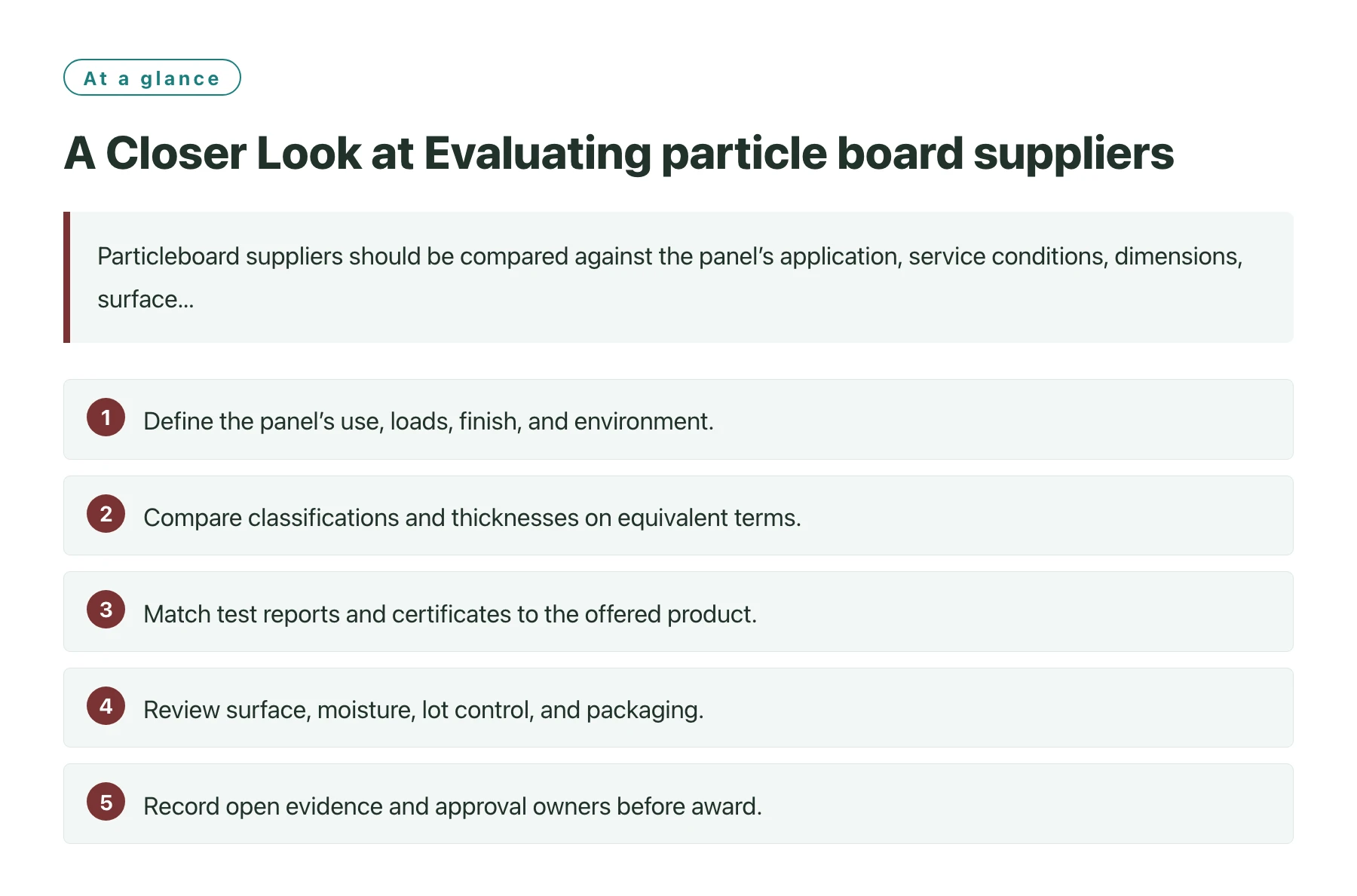
Key takeaways
- Define the panel’s use, loads, finish, and environment.
- Compare classifications and thicknesses on equivalent terms.
- Match test reports and certificates to the offered product.
- Review surface, moisture, lot control, and packaging.
- Record open evidence and approval owners before award.
Panel descriptions can conceal meaningful differences in class, thickness, finish, and service conditions. A controlled comparison makes those differences reviewable.
1. Translate the application into panel requirements
A supplier review should begin with the panel’s actual job. Record whether it will be used in furniture, cabinet components, shelving, interior fit-out, or another application. State expected loads, span, fastener use, finish, edge treatment, humidity exposure, and whether the panel contributes to a structural function. These details drive which product class and evidence matter.
Separate minimum requirements from preferred attributes such as color consistency, surface smoothness, recycled content, or custom dimensions. Identify who sets design values and who approves substitution. When load-bearing performance or regulated construction is involved, obtain requirements from a qualified designer or code professional rather than inferring suitability from a marketing label.
2. Read classifications in the context of use
ISO 16893:2016 covers particleboard classification and manufacturing-property requirements for several use categories and service conditions. Its published values are not characteristic values for design. Confirm with a qualified technical reviewer whether the standard and classification fit the application and destination market. [1]
Ask every supplier to state the exact classification, thickness range, and service condition offered. Do not compare an interior dry-use panel with a moisture-resistant or load-bearing claim as though they were equivalent. Record the name of the standard or test method, edition if relevant, and evidence linked to the specific product.
3. Confirm product identity and factory source
Map the quoted seller, manufacturer, production address, product family, and any exporter or distributor. Ask whether pressing, sanding, lamination, edge treatment, and packing occur at the same facility. A certificate or test report from another plant may not describe the product being offered.
Request current data sheets, production labels, factory details, and references for comparable thicknesses and finishes. Match company names and addresses across the quotation, invoice, report, and sample. If a trading entity coordinates the sale, document how it receives factory records and handles change notices.
4. Compare construction, thickness, and tolerances
Specify nominal and actual thickness, length, width, squareness, flatness, edge quality, density or mass where relevant, moisture range, surface finish, and allowable variation. Include measurement method and sampling points so supplier readings and buyer checks can be compared. Clarify if dimensions are measured before or after coating.
Ask for construction details that affect downstream machining and assembly, such as core consistency, face layers, screw holding, edge sealing, and laminate compatibility. The supplier may protect proprietary formulation, but should provide enough product-specific evidence to evaluate agreed performance and manufacturing consistency.
5. Request relevant test evidence
Ask for test reports that identify sample, thickness, batch, manufacturing site, date, method, laboratory, and measured results. Compare each result against a requirement and note whether it applies to the quoted finish or base board. Review any limitations and make sure a report covers the current production configuration.
Potential tests may address bending, internal bond, density profile, moisture response, surface quality, fastener performance, or emissions depending on intended use and applicable requirements. A qualified technical or regulatory owner should determine which evidence is needed. Avoid assuming one certificate proves every panel property or market claim.
6. Review surface and downstream processing
If the board will be laminated, painted, veneered, drilled, cut, or edge-banded, state the downstream process and tolerances. Request samples with the proposed surface treatment and confirm compatibility with adhesives, coatings, machining, and hardware. Ask how the supplier controls color, gloss, texture, and visual defects across a production lot.
Evaluate a sample under conditions similar to final use. Record panel side, direction, finish code, batch, and date. A sample may be specially selected, so agree how routine production will be compared with the approved reference and what variation requires buyer notification.
7. Evaluate moisture and storage assumptions
State expected relative humidity, temporary outdoor exposure, transport route, storage period, and time between delivery and installation. Ask the supplier for handling, acclimatization, and storage instructions tied to the product. Clarify whether packaging maintains protection during the expected route and what signs should trigger a hold or inspection at receipt.
Moisture resistance labels do not mean the material is waterproof or suitable for every wet environment. Have the technical owner interpret claims against the actual location and assembly. Define any testing or installation detail needed to manage edge exposure, cutouts, sealants, or contact with wet trades.
8. Check quality control and lot traceability
Review incoming raw-material checks, process monitoring, final inspection, calibration where relevant, nonconforming-product control, and complaint response. Follow a recent production record from material lot to finished panel, label, and shipment. Confirm that a defect can be traced to a date, press line, shift, or other useful production identifier.
Ask who can release held material and how rework is documented. Review a corrective-action example with confidential details removed. A supplier’s ability to explain a deviation and show closure evidence can matter as much as the routine pass records.
9. Align packaging and delivery with the product
Specify bundle count, separators, corner protection, strapping, moisture barrier, pallet design, labels, gross weight, and stacking limits. Define how different grades or finishes are separated and identified. Ask for packing photographs or a sample pack where damage risk or unloading method makes packaging important.
Reconcile the quote’s delivery basis, lead time, order quantity, minimum run, replacement process, and claim window. Consider total cost including protective packaging, reinspection, sorting, and expected yield loss. Keep logistics assumptions beside technical differences so an offer is not selected on nominal price alone.
10. Use a structured supplier comparison
Score each supplier on product fit, classification evidence, test scope, dimensional control, surface quality, traceability, packaging, communication, and commercial terms. Keep mandatory gates separate from weighted preferences. List missing records, unverified claims, and approved deviations with an owner and close-by date.
Buyers seeking wholesale construction materials from China can use a common comparison table to evaluate panel suppliers against the same end use and specification. Confirm the actual plant and product identity before award, and retain the final data sheet, sample approval, and shipment criteria with the order.
Sources
Frequently asked questions
What should I compare between particleboard suppliers?
Compare intended use, classification, thickness, tolerances, surface, test evidence, factory identity, traceability, packaging, and delivery terms.
Does moisture-resistant particleboard work in every wet area?
No. Confirm the exact product properties and installation conditions with the qualified designer and applicable market requirements.
Can I rely on a supplier certificate alone?
No. Verify its scope and connect it to the current factory, product, thickness, and relevant test requirements.
How should particleboard samples be approved?
Identify product and finish revision, assess it under representative conditions, and define how production will be checked against the reference.