Appliance Clearances With Pre-Assembled Cabinets
Clearance planning starts with two published depths: the base cabinet is 24 inches front to back and the wall cabinet is 12 inches. Everything around a range or a fridge is arranged inside that 12-inch step. Get the step right and the appliances slide in; get it wrong and the cabinet that looked correct on the drawing fouls a door or a handle on install day.
Key takeaways
- Base cabinets are 24 inches deep and wall cabinets 12 inches deep, so the upper run covers half the lower footprint.
- Widths run from 9 to 42 inches in 3-inch steps, which is what lets a run close out beside an appliance.
- Refrigerator and bridge cabinets come in 12, 15, 18 and 24-inch heights to fill the gap above an appliance bay.
- Within one price band, cost per inch of width falls as the box gets wider: $16.29 at 36 inches against $19.54 at 30 inches.
The 12-inch step decides the layout
A base cabinet stands 34-1/2 inches high and 24 inches deep. A wall cabinet hangs at 12 inches deep. The upper run therefore sits over the back half of the lower run, and the front 12 inches of the base is where feet, knees and countertop overhang live. Any appliance that needs to stand proud of the base line has to be planned against that step.
This is why clearance problems rarely come from the cabinet beside the appliance. They come from the cabinet above it or the tall unit at the end of the run. A 24-inch deep tall cabinet beside a fridge bay eats the space the fridge door needs to swing; a wall cabinet set too close to a hood leaves no room for the duct cover.
Plan the appliances as fixed blocks first, then fill the gaps. CasaBuilt publishes base widths from 9 to 42 inches in 3-inch increments, wall widths from 9 to 39 inches and vanity widths from 12 to 48 inches. That grid is why a run can be closed out precisely instead of ending in a stack of filler strips.
Around a range
A range sets the width of its own alcove, and the cabinets either side have to make up the rest of the wall. The published range-adjacent pieces are more varied than they look. A microwave base is listed at 30 to 33 inches wide for $551.83. An oven cabinet is 33 inches wide, 84 inches high and 24 inches deep for $906.16. A corner base runs 33 to 36 inches at $528.87, and a blind base 33 to 39 inches at $412.62.
Two spatial rules matter more than price. The oven cabinet is a full-height block, so it belongs at the end of a run, not in the middle where it interrupts the counter. And a drawer front set tight against a range body will foul the handle as it pulls out.
Above the range, the bridge and refrigerator cabinets do the filling. CasaBuilt lists bridge cabinets in 12, 15, 18 and 24-inch heights, 12 or 24 inches deep and 24 to 36 inches wide. A 12-inch high bridge at 30 to 36 inches wide is $226.43, and the 24-inch high version is $340.81. The height you choose is the gap between the hood line and the bottom of the upper cabinets, so measure it before ordering.
Around a fridge
A refrigerator bay is a depth problem first and a width problem second. The fridge cabinet above the bay can be 12 inches deep or 24 inches deep, and that choice changes whether the cabinet sits flush with the fridge box or flush with the base run behind it. A 12-inch deep cabinet lines up with the wall cabinets; a 24-inch deep one lines up with the base cabinets and the tall units.
The published heights for that cabinet are 12, 15, 18 and 24 inches, with the 12-inch version at $294.44 and the 24-inch version at $427.36 for a 30 to 36-inch width. Pick the height by measuring from the top of the fridge to the ceiling, then subtract the cabinet and allow for the door swing. A 24-inch high cabinet above a modern fridge leaves very little air above it, and a cabinet door that cannot open past 90 degrees is a storage problem disguised as a design choice.
Depth also decides how the run reads from the doorway: a bay framed by 24-inch deep cabinets looks built in, while the same bay framed by 12-inch deep cabinets leaves the cabinet floating above the appliance. Choose it in the elevation drawing, not on install day.
Paying for the gap by the inch
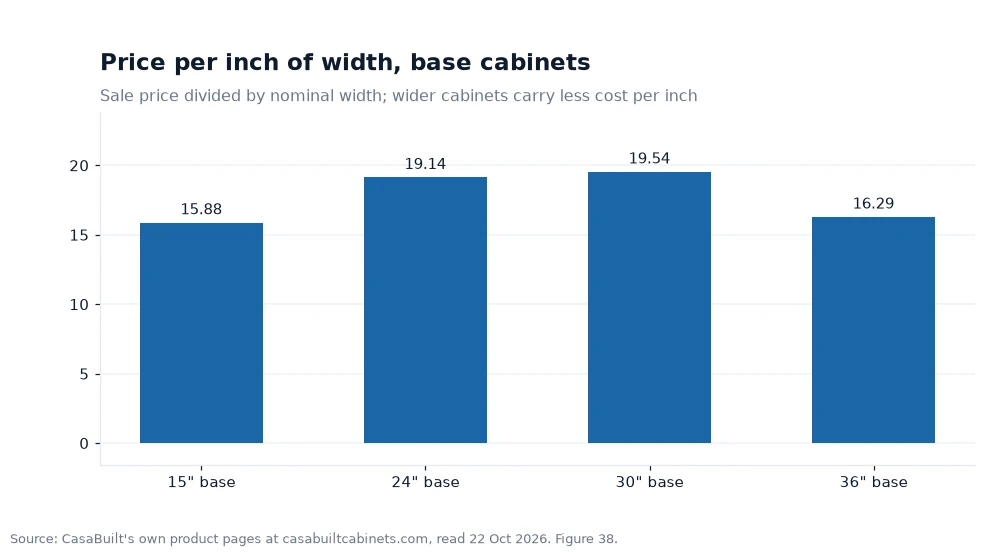
Clearance planning is mostly about dividing a wall into boxes, and the price of that division is not linear. Buyers of pre assembled kitchen cabinets pay per box, so a wider box carries more material but fewer doors, fewer hinges and fewer assembly operations per inch of wall. Within a width band the cost per inch of width falls as the cabinet gets wider; at a band boundary the per-inch figure jumps back up, which is why the chart is not a straight line.
| Appliance zone | Cabinet | Published size | Sale price |
|---|---|---|---|
| Range flank | Double-door base | 24-27 inches wide, 24 deep | $459.26 |
| Range flank | Wide double-door base | 30-42 inches wide, 24 deep | $586.28 |
| Range | Microwave base | 30-33 inches wide | $551.83 |
| Range end | Oven cabinet | 33 wide x 84 high x 24 deep | $906.16 |
| Corner | Corner base | 33-36 inches wide | $528.87 |
| Fridge | Refrigerator cabinet, 12 high | 30-36 inches wide | $294.44 |
| Fridge | Refrigerator cabinet, 24 high | 30-36 inches wide | $427.36 |
| Above range | Bridge cabinet, 12 high | 30-36 inches wide | $226.43 |
The table also shows where the money is not. The gap between a 12-inch high fridge cabinet and a 24-inch high one is $132.92, which buys 12 inches of storage above an appliance. The gap between a 12-inch bridge and the 24-inch version is $114.38. Those are small numbers against the cost of a second delivery, which is why cabinets above an appliance are the last place to economize.
If the wall is still being measured, the published measurement guide is the sensible starting point: the clearance plan is only as good as the wall lengths and the appliance widths that feed it.
Worked example
The chart divides the published sale price of each base by its nominal width. The 15-inch base is $238.24 divided by 15, or $15.88 per inch. The 24-inch base is $459.26 divided by 24, or $19.14. The 30-inch base is $586.28 divided by 30, or $19.54. The 36-inch base is $586.28 divided by 36, or $16.29.
The 30-inch box is the worst value per inch because it carries the same $586.28 price as the 36-inch box but delivers 6 fewer inches of frontage: $586.28 divided by 30 is $19.54 against $16.29 at 36 inches, a difference of $3.25 per inch. The 15-inch box looks cheap per inch at $15.88 only because it is a single-door, single-drawer unit at $238.24; buy two of them and you pay $476.48 for 30 inches, which is $15.88 per inch but two doors, two hinge sets and two boxes to level.
Now apply that to a 72-inch wall beside a range. Three 24-inch bases cost 3 times $459.26, or $1,377.78, which is $19.14 per inch across the run. Two 36-inch bases cost 2 times $586.28, or $1,172.56, which is $16.29 per inch. Same 72 inches of wall, $205.22 cheaper, and two boxes to handle instead of three. Multiply the per-inch figures back out and the chart reconciles within 16 cents of the published prices, because the published per-inch values are rounded to two decimals.
Frequently asked questions
How much space should I leave beside a range?
The published dimensions do not set a clearance figure, so measure the appliance's own installation instructions and then choose cabinet widths from the 9 to 42-inch range to close the gap. Leaving a filler strip beside a range is normal; leaving one that hides a drawer handle is not.
Can a wall cabinet sit directly above a fridge?
Yes, if the height works. Refrigerator cabinets are listed at 12, 15, 18 and 24 inches high and 12 or 24 inches deep, in widths from 24 to 36 inches. Measure from the top of the fridge to the ceiling and allow for the cabinet door to open past 90 degrees before choosing the height.
Why is a 30-inch base more expensive per inch than a 36-inch one?
Because both fall in the same published width band: the 30 to 42-inch double-door base is $586.28 whether it is 30 or 36 inches wide. Dividing that price by 30 gives $19.54 per inch and by 36 gives $16.29, so the wider box in the same band is the better value per inch of wall.
Draw the appliances first
Mark the range, the fridge and the hood on the elevation before you choose a single cabinet. Then fill the remaining wall with the published widths, keeping the 24-inch deep boxes at the base line and the 12-inch deep boxes above. Check every door swing against the appliance, not just the cabinet.
Finish by pricing the run per inch rather than per box. A wall that closes out in two wide cabinets instead of three narrow ones is cheaper, faster to install and easier to keep level, which is the argument for buying them assembled in the first place.
Figures quoted here come from the manufacturer's own website, read 22 Oct 2026[1].