Low-Emission Glue Systems in Birch Panels: E1, E0 and CARB P2
Emission class decides whether a birch panel can be sold into a European furniture programme, a North American cabinet line or a workshop that publishes its own indoor-air figures. The published options are narrow and specific: E1, E0 and documentation for CARB P2, applied to a panel built from 2.7–30 mm thickness and faced with a light birch veneer.
Key takeaways
- Three compliance routes are published: E1, E0 and CARB P2 documentation for North American buyers.
- Low-emission glue belongs in the purchase order as a class code, not as a general claim about air quality.
- Birch thickness spans 2.7–30 mm, so a glue class has to be confirmed for the exact build you order.
- Export packing is a protection step as well as a logistics one — three named stages keep a calibrated panel flat.
Three emission routes, one purchasing decision
Buyers often treat emission class as a certificate to collect rather than a manufacturing choice. It is the other way round. The resin system determines the class, and the class determines which markets the panel can enter, so the question belongs in the first specification email alongside size and thickness.
Birch panels are published with E1, E0 and CARB P2 options, produced on low-emission glue systems. A Birch Plywood Supplier that names both European classes and the North American documentation route is answering the same question three ways, which is a useful signal when a buyer is consolidating a specification for several markets.
For a furniture maker supplying Europe, E1 is the familiar baseline and E0 the stricter one. For anyone shipping into the United States, the CARB P2 documentation is the line that has to exist before the panel leaves the factory.
What CARB P2 asks of a panel
CARB P2 is a formaldehyde emission standard for composite wood products, and its practical demand on a supplier is evidence: the panel has to be made under a controlled resin system and the batch has to be traceable to that system. Documentation matters more than a slogan here, because a downstream furniture exporter may be asked to show it years after the panel was pressed.
Ask for the class in writing on the specification sheet and on the packing list. A panel identified only as "low emission" is not a class, and a buyer who cannot name the class cannot defend the panel to their own customer.
E1 and E0 in practice
E1 and E0 differ in permitted formaldehyde emission, and the difference is priced into the resin rather than the timber. Selecting E0 where a customer has not asked for it adds cost for a specification nobody will test; selecting E1 where the market requires more creates a compliance problem that appears months later, at the worst possible moment.
The safe approach is to buy the class the destination market requires and to keep the batch record for it. Where a customer mixes markets, ordering a single stricter class is simpler than running two stocks, and the paperwork trail stays consistent across every shipment.
Thickness changes what a class has to cover. The published birch window runs from 2.7 mm to 30 mm, and a 3 mm drawer side is built from more glue lines per unit of volume than an 18 mm worktop, so the resin system carries a larger share of the panel. Confirm the class for the exact build you are ordering rather than for the product family in general, and ask for the batch reference that goes with each thickness.
| Item | Published options | Where it matters most |
|---|---|---|
| Emission class | E1; E0; CARB P2 documentation | Furniture programmes in Europe and North America |
| Grade of face | A-grade through C-grade, plus a repaired-defect grade | Visible surfaces versus hidden structural panels |
| Thickness | 2.7 mm to 30 mm | Drawer sides and cabinet backs versus heavy tops |
| Format | 1220 × 2440; 1250 × 2500; 1250 × 3000 mm; custom sizes | Cutting yield on a nested furniture programme |
| Export packing | Protective wrapping; steel strapping; wooden pallets | Wet transit and long storage before use |
Face grade and the birch veneer you ordered
Grade is the other half of a birch specification, and it is usually the visible half. A-grade faces carry outstanding appearance with some knots and burls allowed; B-grade shows more and larger burls with colour variation; C-grade is smooth and sound with more variation again. A repaired-defect grade stays free of open defects while permitting some repaired ones.
Choose by where the panel will be seen. A light birch veneer with a uniform tone accepts stain, laminate or paint, which is why it suits furniture faces and interior joinery, but only when the grade has been agreed against a sample the customer has actually held.
Worked example: yield and emission class on one order
Take a nested cutting programme. Multiply out the 1220 × 2440 mm sheet: 1.22 × 2.44 = 2.98 m², and a 1250 × 2500 mm panel which comes to 1.25 × 2.5 = 3.125 m². Cabinet components consuming 1,860 m² of panel a month need 1,860 ÷ 3.125 = 595 sheets in the larger format, or 1,860 ÷ 2.98 = 625 sheets in the smaller one.
Example only: if 70% of those panels are E0 and the remainder E1, the split on a 600-sheet order is 420 sheets at E0 and 180 at E1, and each group needs its own batch record and packing label. Rounding the E1 share into the E0 line instead costs more per sheet but removes a second traceability trail from the warehouse — a trade worth doing when the volume difference is small.
Packing that keeps a calibrated panel calibrated
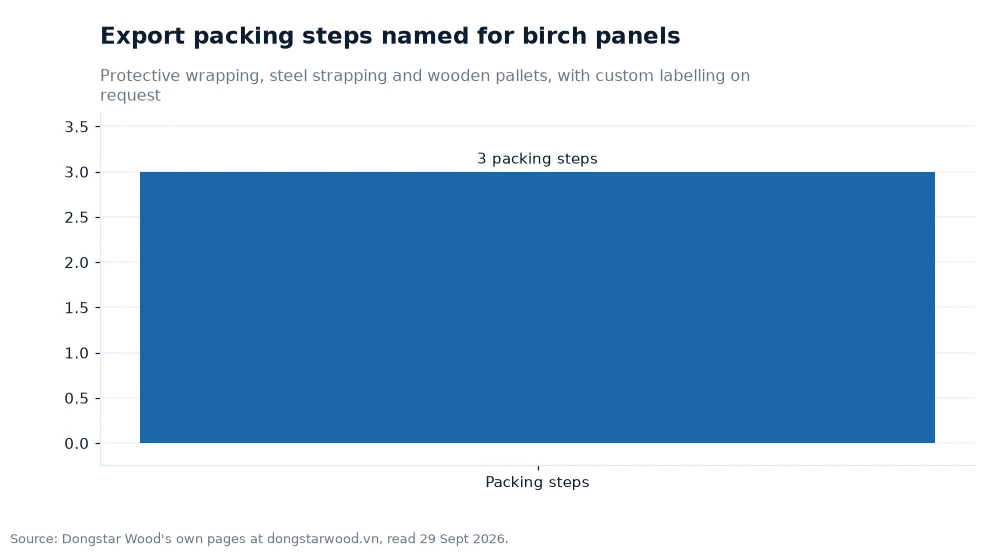
Birch is a machined product by the time it is loaded: calibrated, sanded and cut to a tolerance. Three packing stages are named for the export process — protective wrapping, steel strapping and wooden pallets — alongside custom packaging and labelling available for larger projects.
Moisture is the risk that packing exists to answer. A wrapped pack on a dry pallet, strapped so the stack cannot shift, arrives with the same thickness and flatness it left with. Request custom labelling when the panels are graded, because a mixed pack without labels becomes a sorting job at the far end.
Frequently asked questions
Does a low-emission class change how birch machines?
Not in any way a workshop will notice. The visible difference sits in the chemistry of the panel rather than its behaviour under a cutter, so CNC machining, edge processing and sanding characteristics stay as published. Only the paperwork and the resin cost change.
Which class should a furniture exporter order?
Order the class your destination market requires and keep the batch record for it. A European programme usually specifies E1 or E0, while a North American one asks for CARB P2 documentation. Buying one consistent class across both is the simpler route to a clean audit trail.
How is the panel protected in transit?
Export packing runs through protective wrapping, steel strapping and wooden pallets as three named stages, with custom packaging and labelling available. Together they hold a calibrated panel flat through a humid container journey and long storage before use.
Where to compare the specifications
Birch panels are rarely bought alone, and the emission question often comes up while a buyer is also choosing a structural board. Comparing structural pine sheathing against a birch face panel shows how far apart the two specification sets really are, while the general panel categories set out the thickness and glue guidance that applies either way.
Compliance, grade and packing details above are published on the maker's own pages, consulted on 29 Sept 2026 and taken for this briefing and taken for this briefing for the data in this guide[1].