Sizing a 0.1 BTC Monthly Target Before You Buy Racks
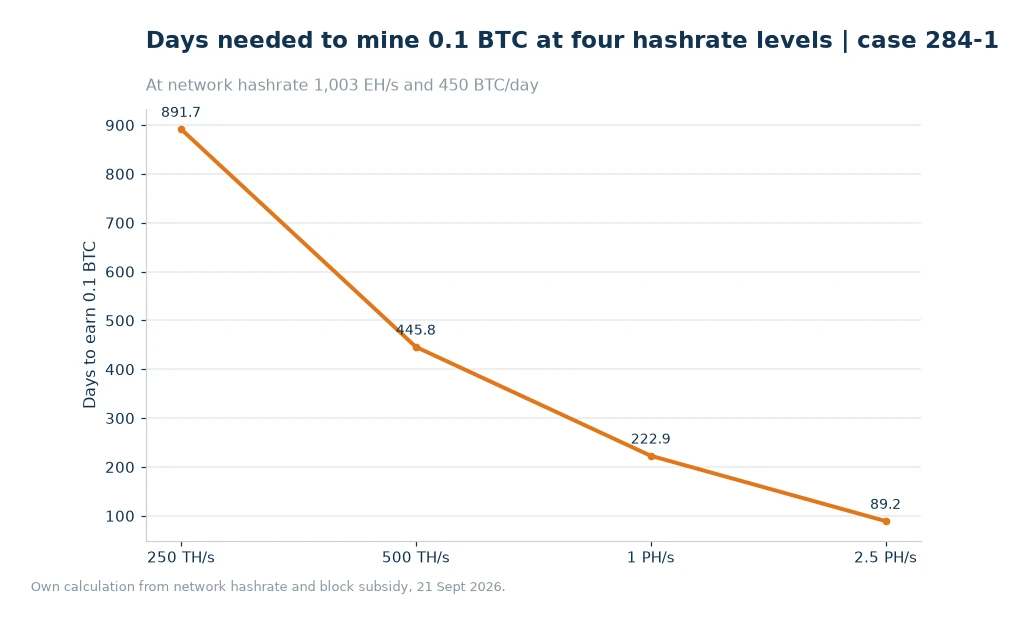
A purchase order is easier to defend when it starts from output rather than from a spec sheet. Producing 0.1 BTC in thirty days takes about 7.4 PH/s at 1,003 EH/s, and the same 0.1 BTC takes 89.2 days at 2.5 PH/s or 891.7 days at 250 TH/s. Those four numbers frame every hardware decision that follows.
Key takeaways
- 0.1 BTC is worth about $8,469.20 at $84,692, and the coin amount does not change with the hardware you pick.
- At 250 TH/s the target takes 891.7 days; at 2.5 PH/s it takes 89.2, a tenfold difference in hashrate.
- A thirty-day schedule needs roughly 7.4 PH/s, which is a facility decision rather than a garage one.
- Pool Hashrate and Pool Luck describe the pool, not your rig, so neither replaces the division on your own numbers.
Begin with the coin target, not the catalogue
Hardware shopping has a gravity of its own. Efficient machines look attractive, discounts look urgent, and the question of how much coin the rack will actually produce arrives late. Reversing the order costs nothing and prevents the most common disappointment: a well-chosen machine attached to a target it cannot reach in a reasonable time.
Start with a coin figure and a deadline. Both are arbitrary, and that is fine. What matters is that they are explicit before a price is quoted, because a target plus a deadline converts directly into a hashrate requirement. Once that requirement exists, every machine on the market can be judged against the same bar instead of against its neighbours in a comparison table.
There is a second benefit, less obvious but worth the effort. A target gives the project a stopping point. Racks expand by default when nothing defines success, and each addition brings power, cooling and monitoring work that nobody priced at the start. A written figure of 0.1 BTC says when the build is finished, which is a surprisingly rare property in mining projects.
Converting a target into terahash
The conversion uses the network's daily production, not the price, and the published rate sheet supplies the fee side of the same comparison. At the 21 Sept 2026 reading, 1,003 EH/s of network hashrate earns 450 BTC a day, which is 0.00000044865 BTC per terahash per day. Divide the coin target by the deadline to get a daily requirement, then divide that by the per-terahash figure. A 0.1 BTC target over thirty days needs 0.00333 BTC a day, or about 7,432 TH/s.
That last number is the one that changes a plan. Seven point four petahash is not a pair of desktop units; it is a container or a hosted hall with a power budget in the hundreds of kilowatts. A buyer who works the arithmetic first discovers the scale of the project before signing anything, which is the cheapest possible time to discover it.
The same division works in reverse and is just as useful. Given a quote for 200 TH/s, divide 0.1 BTC by its daily output of 0.00008972 BTC and the answer is 1,114.6 days: three years for a target that sounded like a monthly one. Running that check on every candidate stops a vague ambition from being dressed up as a schedule.
Four configurations and their calendars
The rows below answer a different question: given a machine, how long until 0.1 BTC? Calendar months use 30.4 days.
| Configuration | BTC per day | Days to 0.1 BTC | Calendar months |
|---|---|---|---|
| 250 TH/s | 0.00011215 | 891.7 | 29.3 |
| 500 TH/s | 0.00022430 | 445.8 | 14.7 |
| 1 PH/s | 0.00044861 | 222.9 | 7.3 |
| 2.5 PH/s | 0.00112152 | 89.2 | 2.9 |
The spread between the top and bottom row is a factor of ten, which mirrors the hashrate ratio exactly. Nothing in the pool penalises a small configuration: 250 TH/s earns its proportional share, hour after hour. The penalty is entirely in the calendar, and a calendar is often the resource a buyer forgets to budget.
It is worth stating the same point in power terms, because that is where a small configuration can quietly lose. A 250 TH/s unit at 20 J/TH draws about 5 kW, or 120 kWh a day, and the coin it produces in that day is 0.00011215 BTC. Whether the margin survives depends on the local tariff rather than on the pool, and a target that ignores power is only half a business case. Two sites with identical machines can reach very different conclusions for that reason alone.
Worked example
Follow the 500 TH/s row from network output to a finished target.
- Per terahash per day: 450 ÷ 1,003,000,000 = 0.00000044865 BTC.
- At 500 TH/s: 500 × 0.00000044865 = 0.00022430 BTC a day.
- Days for the target: 0.1 ÷ 0.00022430 = 445.8 days.
- Cross-check at 2.5 PH/s, five times the hashrate: 0.00112152 BTC a day, so 0.1 ÷ 0.00112152 = 89.2 days.
- Dollar value of the target: 0.1 × 84,692 = $8,469.20, unchanged by machine size.
- Thirty-day requirement at 0.1 BTC: 0.00333 a day, which needs about 7.4 PH/s.
Where Pool Luck fits a monthly plan
Pool Luck belongs in a monthly review, not in the production model. It compares the blocks a pool found with the blocks its share of the network would suggest, and it swings widely over short windows. Under PPS+ a miner's block-reward credit is settled against difficulty, so a lucky month for the pool does not flatter your balance, and an unlucky one does not dent it.
The ViaBTC BTC Mining Pool page reports both Pool Hashrate and Pool Luck beside each other, which is the right way to read them. A pool growing its share and finding blocks in line with expectation is a boring, healthy picture. A pool shrinking its share deserves a question, because your own contribution to it is far smaller than the total.
Buying for a difficulty that keeps rising
Every calendar in this article assumes a fixed difficulty, and none of them will hold for 891 days. The next estimate at the time of writing pointed to a 2.12% decrease, which is a single reading, while the longer trend has mostly been upward. For a two-year target that matters a great deal: each rise reduces daily output and extends the remaining days.
The practical response is to build in slack rather than to forecast precisely. If the configuration needs 891.7 days at today's difficulty, a buyer who wants the target inside two years needs more hashrate than the naive calculation suggests. The Miner Profitability Ranking is a reasonable place to compare machines under current conditions, but the difficulty assumption is yours to choose.
Frequently asked questions
How much hashrate produces 0.1 BTC in a month?
About 7.4 PH/s at 1,003 EH/s and 450 BTC a day. Thirty days at 0.00333 BTC a day requires roughly 7,432 TH/s, which is a hosted or container-scale operation.
Why does 2.5 PH/s need only 89.2 days?
Because it is ten times the hashrate of the 250 TH/s row, and daily output scales in direct proportion. Ten times the daily coin means one tenth of the days for the same 0.1 BTC target.
Does Pool Luck change the schedule for a PPS+ miner?
No. The block-reward component settles against current difficulty each hour, so the schedule depends on hashrate and difficulty rather than on how many blocks the pool happened to find.
Put the target on the order sheet
Write three lines before the next quotation: the coin target, the deadline, and the hashrate those two imply. At 0.1 BTC in a month the answer is about 7.4 PH/s, and any quote that falls short of it is a different project with a longer calendar. A supplier who sees those three lines will price the job honestly, and a plan that starts with them is much harder to talk out of shape.
Sources: ViaBTC's pool state, miner ranking and price pages[1]. Inputs are the 21 Sept 2026 chain snapshot: 1,003 EH/s, 132.76 T, 3.125 BTC every block, 144 blocks a day, $84,692 per BTC. Calendars assume constant difficulty and full uptime; published 24 Oct 2026.