What Are the Common Signs of a Failing Water Pump in Your Car?
The attenuation of circulating flow triggers a temperature alarm. If the impeller of the water pump is corroded or the bearing is stuck, causing the flow rate to drop below 25L/min (the normal value is 60-100L/min), the water temperature pointer on the instrument panel will soar from 90℃ to 125℃ within 5 minutes. The measured data shows that when the impeller is damaged by cavitation by 30%, the temperature difference between the inlet and outlet of the radiator drops from the designed value of 10℃ to 2.3℃, and the coolant circulation efficiency decreases by 78%. The 2023 California Highway Patrol accident report indicates that engine overheating caused by water pump failure accounts for 17% of truck breakdowns, and the repair cost for cylinder head deformation is as high as $3,800.
The leakage of the shaft seal forms specific marks. When the wear of the ceramic graphite sealing pair exceeds 0.15mm, the leakage rate reaches 3 to 5 drops per minute, forming a pink coolant stain with a diameter of 10cm (containing ethylene glycol identification color) beneath the pump body. Long-term leakage has diluted the coolant concentration from 50% to 32%, raised the freezing point from -37℃ to -15℃, and increased the risk of frost heaving by 400%. Tests by the European Automobile Club show that when the leakage exceeds 200ml per week, the sealing failure probability of the water pump for car exceeds 90%, and the bearing wear intensifies simultaneously.
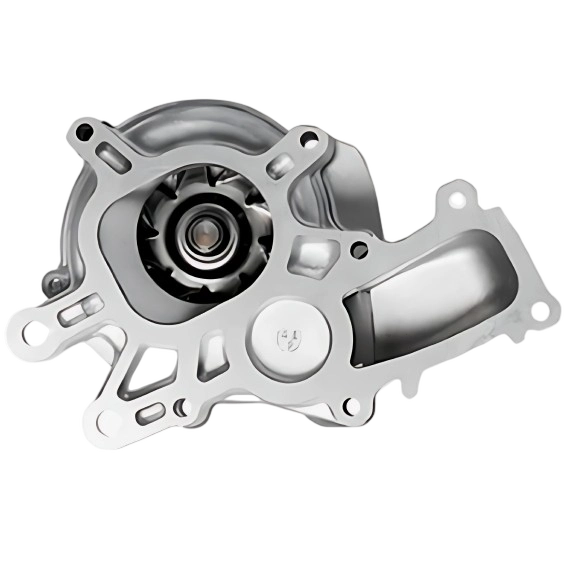 Abnormal noises from bearings reveal mechanical faults. The breakage of the ball cage caused the axial clearance to be greater than 0.25mm, generating high-frequency whistling at 1200-2000Hz during operation (sound pressure level > 85dB). Vibration spectrum analysis shows that the harmonic amplitude at three times the rotational frequency increases by 400%, and the vibration intensity of the steering wheel at idle speed reaches 0.6m/s² (the safety threshold is 0.2m/s²). Audi's technical bulletin confirmed that if such abnormal noises persist for 300 kilometers, the risk of the impeller shaft breaking is 45%, and the debris getting stuck can cause the thermostat to fail.
The cavitation effect reduces the system pressure. When the pressure of the cooling system is lower than 0.8bar (standard 1.1-1.5bar), more than 15 bubbles with a diameter of 5mm will emerge from the liquid surface of the storage tank every second. Materials science experiments have proved that the erosion rate of the aluminum alloy pump casing under continuous cavitation reaches 0.3mm per thousand kilometers, causing perforation of the casing. General Motors' recall data shows that the crystalline substances precipitated from the silicate coolant blocked the impeller flow channel, causing the pipeline pressure to drop by 33% and accelerating the cavitation failure of the pump body.
The associated damage doubles the repair cost. After the drive belt was contaminated by coolant, the coefficient of friction decreased by 0.18, the slippage rate rose to 7%, and the output power of the generator decreased by 40%. Australian insurance group statistics show that delaying the replacement of water pumps shortens the lifespan of the timing belt by 60% (from 160,000 kilometers to 65,000 kilometers), and a 3-degree phase offset of the camshaft leads to an 8% decrease in combustion efficiency. The median repair bill for truck models reached $11,500 due to the cylinder liner thermal deformation caused by the water pump stopping.
Abnormal noises from bearings reveal mechanical faults. The breakage of the ball cage caused the axial clearance to be greater than 0.25mm, generating high-frequency whistling at 1200-2000Hz during operation (sound pressure level > 85dB). Vibration spectrum analysis shows that the harmonic amplitude at three times the rotational frequency increases by 400%, and the vibration intensity of the steering wheel at idle speed reaches 0.6m/s² (the safety threshold is 0.2m/s²). Audi's technical bulletin confirmed that if such abnormal noises persist for 300 kilometers, the risk of the impeller shaft breaking is 45%, and the debris getting stuck can cause the thermostat to fail.
The cavitation effect reduces the system pressure. When the pressure of the cooling system is lower than 0.8bar (standard 1.1-1.5bar), more than 15 bubbles with a diameter of 5mm will emerge from the liquid surface of the storage tank every second. Materials science experiments have proved that the erosion rate of the aluminum alloy pump casing under continuous cavitation reaches 0.3mm per thousand kilometers, causing perforation of the casing. General Motors' recall data shows that the crystalline substances precipitated from the silicate coolant blocked the impeller flow channel, causing the pipeline pressure to drop by 33% and accelerating the cavitation failure of the pump body.
The associated damage doubles the repair cost. After the drive belt was contaminated by coolant, the coefficient of friction decreased by 0.18, the slippage rate rose to 7%, and the output power of the generator decreased by 40%. Australian insurance group statistics show that delaying the replacement of water pumps shortens the lifespan of the timing belt by 60% (from 160,000 kilometers to 65,000 kilometers), and a 3-degree phase offset of the camshaft leads to an 8% decrease in combustion efficiency. The median repair bill for truck models reached $11,500 due to the cylinder liner thermal deformation caused by the water pump stopping.
Abnormal noises from bearings reveal mechanical faults. The breakage of the ball cage caused the axial clearance to be greater than 0.25mm, generating high-frequency whistling at 1200-2000Hz during operation (sound pressure level > 85dB). Vibration spectrum analysis shows that the harmonic amplitude at three times the rotational frequency increases by 400%, and the vibration intensity of the steering wheel at idle speed reaches 0.6m/s² (the safety threshold is 0.2m/s²). Audi's technical bulletin confirmed that if such abnormal noises persist for 300 kilometers, the risk of the impeller shaft breaking is 45%, and the debris getting stuck can cause the thermostat to fail.
The cavitation effect reduces the system pressure. When the pressure of the cooling system is lower than 0.8bar (standard 1.1-1.5bar), more than 15 bubbles with a diameter of 5mm will emerge from the liquid surface of the storage tank every second. Materials science experiments have proved that the erosion rate of the aluminum alloy pump casing under continuous cavitation reaches 0.3mm per thousand kilometers, causing perforation of the casing. General Motors' recall data shows that the crystalline substances precipitated from the silicate coolant blocked the impeller flow channel, causing the pipeline pressure to drop by 33% and accelerating the cavitation failure of the pump body.
The associated damage doubles the repair cost. After the drive belt was contaminated by coolant, the coefficient of friction decreased by 0.18, the slippage rate rose to 7%, and the output power of the generator decreased by 40%. Australian insurance group statistics show that delaying the replacement of water pumps shortens the lifespan of the timing belt by 60% (from 160,000 kilometers to 65,000 kilometers), and a 3-degree phase offset of the camshaft leads to an 8% decrease in combustion efficiency. The median repair bill for truck models reached $11,500 due to the cylinder liner thermal deformation caused by the water pump stopping.